
When healthcare leaders discuss digital innovation, attention often turns first to platforms, devices, artificial intelligence or data. Yet the most important question is usually much simpler: does the innovation make a meaningful difference to the people we serve?
Patient-centred innovation starts with an unmet need, not a technology trend
ParaVerse began at the Swiss Paraplegic Centre in Nottwil with a human challenge: how could people with severe physical impairments gain greater independence, privacy and participation in the digital world when conventional interfaces were no longer accessible to them?
Starting with the unmet need
People living with tetraplegia can face profound changes in their daily lives following spinal cord injury. During early rehabilitation, some people may be unable to use their hands and may also have limited possibilities for conventional communication because of ventilatory support or other medical interventions.
Tasks that most of us take for granted — reading a message, replying privately, browsing information or communicating with family — can then depend on assistance from healthcare professionals or relatives. The consequences go beyond convenience. They touch autonomy, privacy and dignity.
“How can we make the digital world accessible to people who can no longer use their hands?”
Designing with patients, not for patients
ParaVerse was developed through a co-design process involving people with lived experience of spinal cord injury, therapists, clinicians, technology specialists and rehabilitation professionals. Their feedback shaped priorities, interfaces and functionality throughout development.
One of the most important lessons was that features considered technologically sophisticated were not necessarily those that mattered most to users. Simplicity, reliability and ease of use repeatedly proved more relevant than complexity.
Bringing eye-controlled XR into rehabilitation
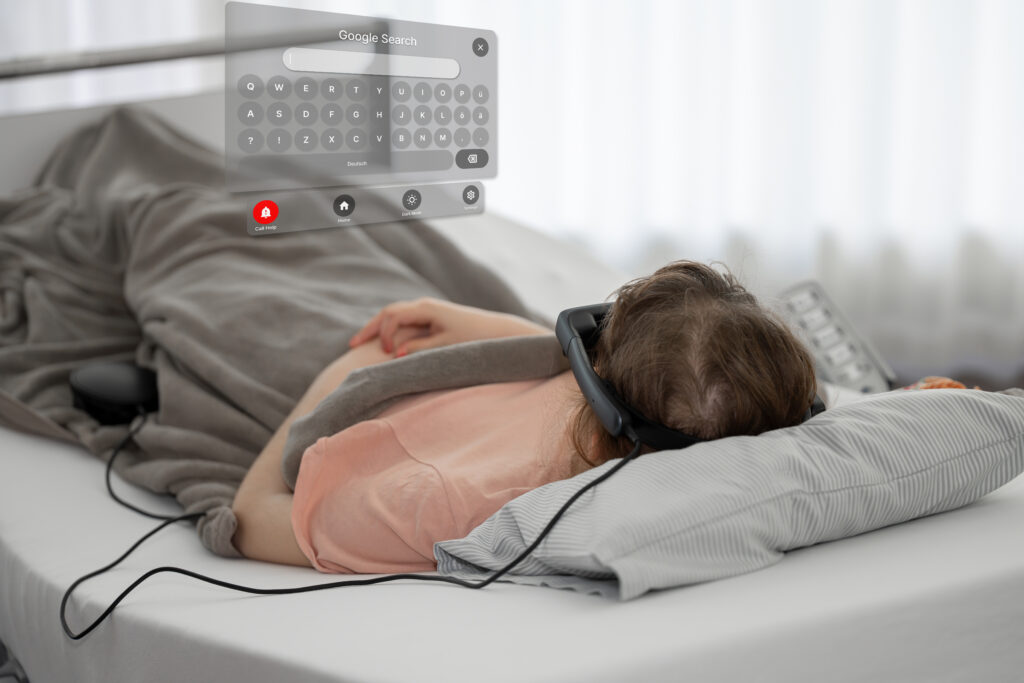
Developed by the Swiss Paraplegic Centre together with Augment IT, ParaVerse uses extended reality glasses with eye-tracking capabilities. Users can navigate digital environments and applications through eye movements without relying on hand controllers, keyboards or voice commands.
Our experience quickly challenged some assumptions about what users would value most. People were often less interested in entering sophisticated virtual worlds than in carrying out familiar activities independently: watching videos, reading news, browsing the web or sending messages.
For someone who depends on others to access a screen, independently sending a private message can matter more than an impressive technological demonstration.
Innovation becomes a management challenge when it enters practice
Introducing the technology into rehabilitation required much more than a functioning device. Therapists supported onboarding and adaptation. Nursing teams helped identify suitable users and integrate the solution into daily care. Technical specialists supported reliable operation. Clinical and organisational leaders created the space for experimentation, learning and adaptation.
No single professional group could have implemented the project successfully alone. This is a useful reminder for healthcare leaders: digital innovation becomes an organisational intervention as soon as it enters real clinical practice.
Co-design
Involve end users early enough for their experience to change the solution, not merely validate it afterwards.
Multidisciplinary ownership
Combine patient experience with clinical, operational, technical and leadership expertise.
Workflow fit
Technology must fit the realities of frontline work rather than create additional complexity for professionals.
Implementation space
Teams need permission to test, learn, adapt and establish sustainable ways of working.
What users valued: independence, privacy and participation
In our project experience, users valued the possibility of accessing digital content and communicating with other people more independently. For some, being able to read or send messages without requiring another person to operate a device restored an element of privacy that conventional solutions could not provide.
The rehabilitation team also observed that independent access to information, entertainment and social interaction could become a meaningful part of the rehabilitation experience. These observations are not a substitute for formal clinical evaluation, but they helped the team understand which dimensions of the technology mattered most to users.
A different way to think about digital outcomes
Technical performance matters. But in patient-centred innovation, privacy, autonomy, participation and ease of use may be equally important measures of whether a solution creates meaningful value.
Innovation also means managing limitations
Extended reality is evolving rapidly. Hardware platforms change, devices may become obsolete and long-term technology roadmaps are not always predictable. For healthcare organisations, this reinforces the importance of flexibility and of avoiding unnecessary dependence on a single technological platform.
Implementation creates another challenge. Pilot projects can function well because they receive special attention. Routine use requires reliable processes, training, governance, technical support and alignment with clinical workflows.
For ParaVerse, this meant investing substantial effort in making setup and configuration fast, stable and manageable for therapists and nursing staff. A promising technology that repeatedly creates additional work for frontline teams is unlikely to become sustainable practice.
Accessibility is not a feature added at the end of development. It is a design philosophy that must shape assumptions from the beginning.
Four lessons for healthcare leaders
The ParaVerse experience suggests principles that extend beyond rehabilitation medicine and beyond any single technology.
Start with a real patient problem
Technology should respond to an identified need rather than create a search for possible applications.
Co-design continuously
End-user involvement should continue throughout design and implementation so that experience can genuinely reshape priorities.
Measure what matters to people
Technical performance should be considered alongside outcomes such as autonomy, usability, privacy and participation.
Treat implementation as multidisciplinary work
Clinical expertise, operational leadership, technology knowledge and patient experience need to come together if innovation is to become sustainable practice.
Looking ahead
The ParaVerse journey is still evolving. New generations of smart glasses, lighter hardware, improved artificial intelligence and more natural interaction models may expand the possibilities for digital accessibility.
The principles behind the project may also be relevant beyond spinal cord injury rehabilitation, particularly where neurological conditions, severe motor impairments or other disabilities limit conventional interaction with digital systems.
For healthcare leaders, however, the broader lesson does not depend on what the next device looks like. Meaningful innovation begins by understanding a real human need and succeeds only when technology, people, workflows and organisational leadership are designed together.
The question is not how advanced the technology is.
The question is whether it expands what people can do for themselves.
Beyond technology, patient-centred innovation is ultimately about autonomy, inclusion and meaningful participation.
Disclosure of interests
Ulrich Kössl and Stefan Stalder are affiliated with the Swiss Paraplegic Centre and were directly involved in the ParaVerse project. ParaVerse was developed by the Swiss Paraplegic Centre together with Augment IT.
References and source notes
- Swiss Paraplegic Centre — Extended Reality in Day-to-Day Clinic Operations.
Institutional information on the ParaVerse project, its eye-controlled extended reality approach and its intended contribution to greater digital independence and privacy for people with limited hand function. - Swiss Paraplegic Foundation — Design for Inclusion.
Further information on ParaVerse and other initiatives aimed at improving inclusion and quality of life for people living with spinal cord injury. - Source note.
Descriptions of implementation experience and user response in this article are based on the authors’ professional experience with the ParaVerse project. They should not be interpreted as results from a controlled clinical effectiveness study.
Professional experience. Independent perspectives. European dialogue.
Contributing to Europe’s healthcare management conversation.