Healthcare leadership can no longer stop at organisational boundaries. At the Health Management Institute of Ireland (HMI) Annual Conference 2026, EAHM President Alexandre Lourenço explored why modern health systems require leaders capable of connecting organisations, professionals and communities — and why structural integration alone is not enough to deliver integrated care.
Dublin, Ireland | 22 October 2026
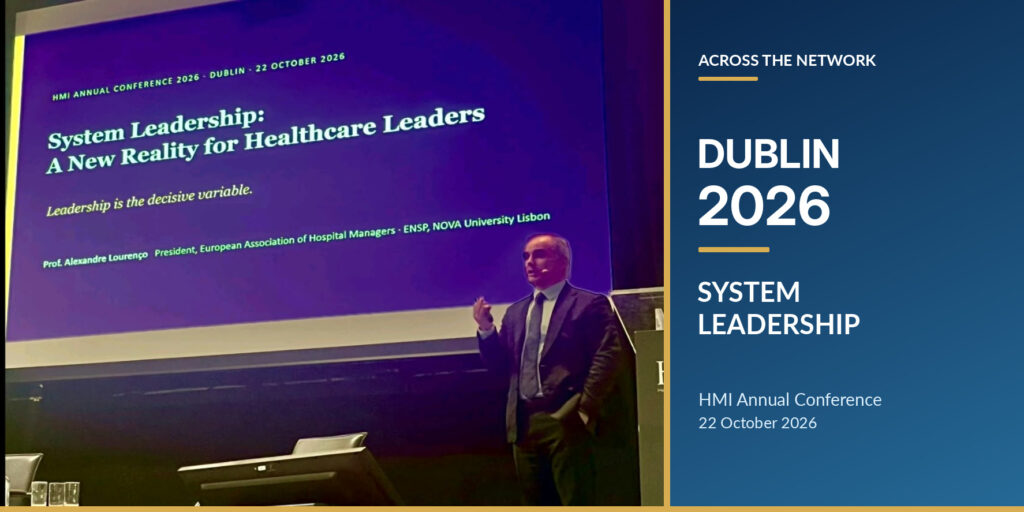
The Health Management Institute of Ireland (HMI), a Full Member Association of the European Association of Hospital Managers (EAHM), held its Annual Conference on 22 October 2026 at the RDS in Dublin.
Under the theme “System Leadership–Driven Modernisation of Health and Social Care”, the conference brought together healthcare managers and leaders to examine the capabilities needed to modernise increasingly interconnected health and social care systems.
EAHM President Prof. Alexandre Lourenço contributed to the programme with a presentation entitled “System Leadership: A New Reality for Healthcare Leaders”.
Drawing on European evidence and practical experience from Ireland and Portugal, he addressed a fundamental management challenge: healthcare leaders are increasingly expected to deliver outcomes that depend on organisations and professionals beyond their direct authority.
Leadership beyond organisational boundaries
“Health leaders are now accountable for outcomes they do not control.”
This observation, presented by Alexandre Lourenço, captures the central challenge of system leadership: responsibility for the entire patient journey increasingly extends beyond the formal authority of any single institution.
Why system leadership is becoming essential
Healthcare systems were historically organised around individual institutions, professional structures and separate levels of care. Yet patients increasingly require coordinated responses across hospitals, primary care, community services, social care and their own homes.
In his presentation, Lourenço identified three major forces accelerating the transition towards system leadership.
Ageing and complexity
Ageing populations, frailty and multiple chronic conditions require continuous, coordinated responses rather than isolated episodes of hospital treatment.
Scarce professional capacity
Workforce shortages, burnout and changing professional expectations make retention and cooperation across organisations essential management priorities.
Connected decisions and care
Digital tools, health data and artificial intelligence create greater value when they support shared decisions and connected care pathways.
The implication for healthcare management is significant. Hospitals remain essential, but increasingly function as part of wider networks of care rather than isolated institutions.
System leadership therefore requires managers to consider not only the performance of their own organisation, but also how effectively it contributes to population health, patient experience and continuity of care across different services.
Ireland and Portugal: different structures, a shared direction
A particularly relevant part of the presentation compared the development of integrated healthcare structures in Ireland and Portugal.
Both countries have introduced significant organisational reforms intended to improve coordination, reduce fragmentation and strengthen accountability for the health of defined populations.
Health Regions and integrated care
Ireland established six HSE Health Regions in 2024, with Integrated Healthcare Areas designed to improve coordination between hospitals, primary care and community services.
The reform aims to strengthen regional responsibility, improve service integration and organise care more effectively around population needs.
Local Health Units
Portugal extended its Local Health Unit model in January 2024, integrating hospitals and primary healthcare services under shared organisational governance.
The model seeks to improve continuity of care, population-based responsibility and coordination between different levels of healthcare.
Although the organisational designs differ, both reforms reflect a common direction: moving from institution-centred management towards responsibility for the care of an entire population.
However, Lourenço cautioned against assuming that changes in organisational structures automatically produce integrated care.
“Merging boards does not integrate care. People do.”
Alexandre Lourenço · EAHM President
From structural reform to operational transformation
The presentation illustrated the practical implications of system leadership through the experience of the Local Health Unit of Coimbra (ULS de Coimbra), where Alexandre Lourenço previously served as Chairman of the Board.
Rather than responding to emergency department pressure exclusively through additional hospital capacity, the organisation developed an approach designed to improve how patients access different levels of care.
The experience combined three operational elements:
1. Telephone triage: directing patients towards the most appropriate level of care through a nurse-led clinical telephone service.
2. Flexible primary care: adjusting service availability and same-day appointments in response to observed demand.
3. Community-based acute care: developing intermediate responses with observation and basic diagnostic capabilities, linked to the triage pathway.
Reported operational results from Coimbra
Using operational figures presented during his address, Lourenço reported a reduction in emergency department episodes between the 2022/23 and 2024/25 seasons.
Emergency department episodes decreased from 251,365 in 2022/23 to 210,841 in 2024/25.
Figures presented by Alexandre Lourenço, based on ULS de Coimbra operational data. These descriptive comparisons do not, by themselves, establish the causal effect of a specific intervention.
The example illustrates an important management principle: improving patient flows does not always depend on expanding hospital infrastructure. It may require better coordination, more appropriate access pathways, shared information and the effective use of existing capacity.
Four shifts for healthcare leaders
Moving towards system leadership requires new management behaviours and competencies. Lourenço outlined four particularly important shifts.
From institution to system
Move beyond the performance of an individual organisation and consider how it contributes to integrated pathways, population health and outcomes across the system.
From capacity to people
Put workforce retention, professional development, working conditions and the sustainable organisation of professional capacity at the centre of management.
From control to enabling
Create conditions for professionals and organisations to collaborate, solve problems and innovate beyond traditional hierarchies and organisational boundaries.
From firefighting to stewardship
Extend leadership responsibility beyond immediate operational pressures towards financial, environmental and community sustainability.
Leadership and management competencies must be recognised and measured
A further message of the presentation concerned the professionalisation of healthcare management.
If management and leadership influence the quality, accessibility and sustainability of healthcare, then the competencies required to exercise these responsibilities must be clearly defined, developed and evaluated.
Lourenço referred to the International Hospital Federation’s healthcare management competency framework as an important reference for modern healthcare executives, particularly in relation to context management and transformation.
He also highlighted HELM-S, which he described as work involving EAHM, the NOVA National School of Public Health and the World Health Organization to examine leadership and management in European hospitals.
Management is a professional capability
Effective healthcare management requires specific competencies, structured professional development and evidence-informed assessment. Leadership must be recognised not simply as an individual quality, but as a capability that health systems should deliberately develop.
What does this mean for hospital boards?
The discussion in Dublin raises practical questions for healthcare managers and governing bodies across Europe.
Five questions for healthcare leaders
1. Are we managing the performance of our institution or the outcomes of the populations we serve?
2.Where do organisational boundaries continue to create avoidable fragmentation in patient pathways?
3.Are workforce, data and resources coordinated effectively across services?
4.Do our leadership development programmes prepare managers to collaborate beyond their formal authority?
5.How are we measuring the contribution of management and leadership to healthcare transformation?
The importance of professional exchange across Europe
The HMI Annual Conference provided an opportunity to connect Ireland’s health-system reform agenda with experiences and perspectives from other European countries.
For EAHM, the value of its network lies in bringing different national approaches into a shared professional discussion, identifying transferable lessons and supporting the development of management capabilities across Europe.
The experience presented in Dublin reinforces the need to move beyond organisational structures towards leadership practices that connect institutions, professionals, services and communities.
Better leadership across boundaries. Better care across systems.
System leadership is increasingly essential to making integrated care a reality.
EAHM perspective
EAHM congratulates the Health Management Institute of Ireland on organising its 2026 Annual Conference and promoting an essential discussion on the modernisation of health and social care.
The Association extends its thanks to Breda Crehan-Roche, HMI President, Rosemarie Carroll and the entire HMI team for the invitation and for their continued commitment to professional management and leadership development.
At a time when health systems are increasingly interconnected, the challenge is not simply to manage individual organisations more effectively. It is to develop leaders who can work across boundaries, share responsibility and translate cooperation into better outcomes for patients and communities.
A question for European healthcare leaders
What will you share tomorrow — whether data, workforce or resources — with an organisation you do not directly control?
Further information
EAHM Member News
Sharing the experience, knowledge and perspectives of EAHM Full Member Associations contributes to a stronger European healthcare management community.