

PRISME was created around a simple ambition: to bring innovative, highly specialised care as close as possible to people living in a rural territory, while connecting the expertise and resources already present around them.
PRISME — a highly specialised multidisciplinary territorial team
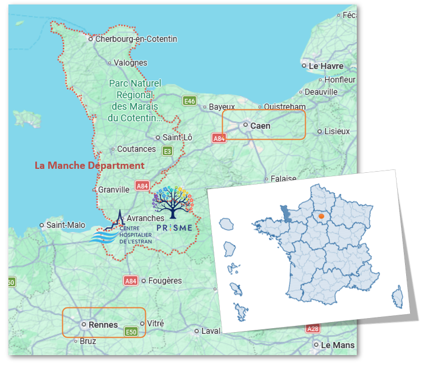
PRISME is a new division of the Centre Hospitalier de l’Estran, a public hospital based in Pontorson, Normandy, France. Its premises are located in Avranches, only a few kilometres from Mont-Saint-Michel, in a predominantly rural territory at some distance from the university hospitals of Rennes and Caen.
For people living in the Manche department, access to highly specialised expertise can therefore involve considerable geographical distance. PRISME was developed to respond to that challenge by organising specialist capabilities closer to patients while maintaining strong links with regional and national centres of expertise.
Five founding principles
PRISME rests on five founding principles that shaped both its clinical model and its organisation.
Bring specialised care closer
Bring innovative and highly specialised care as close as possible to a rural population.
Federate existing resources
Connect territorial resources to optimise the patient pathway instead of allowing services to operate in isolation.
Develop local expertise
Provide continuous training in neurodevelopment and genetics at departmental and local level.
Give a peripheral hospital an academic dimension
Develop structured research and academic activity alongside territorial clinical care.
Remain connected to excellence
Strengthen national and international links in order to maintain quality, expertise and professional development.
The first challenge was organisational
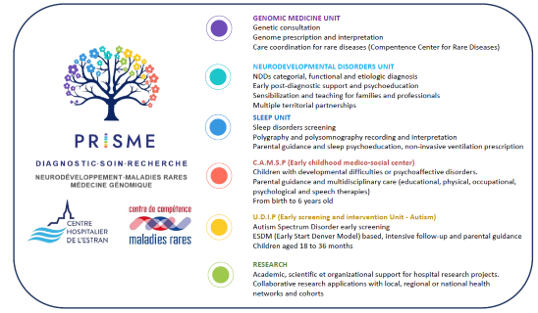
Genetics, the CAMSP early medico-social action centre and the neurodevelopmental disorders unit had initially developed as successive building blocks attached to child and adolescent psychiatry. Bringing them together in an autonomous division made the dual health and medico-social nature of the service clearer to partners and regulators and allowed scarce expertise to be pooled around a single patient pathway.
Genetics and mental health in France: a changing context
Neurodevelopmental disorders require coordinated care
The evolution of medical understanding of neurodevelopmental disorders has progressively placed them at the crossroads of neurology and psychiatry, while also requiring close connections with genetics, paediatrics, rehabilitation, education and social support.
Neurodevelopmental disorders affect a substantial share of the population and represent a major public-health issue. Their diversity in intensity, presentation and functional impact requires a network able to combine prevention, early identification, diagnosis, coordinated care and support for families and professionals surrounding the patient.
In France, early identification and diagnosis have become national priorities. The law of 15 November 2024 and the national strategy for neurodevelopmental disorders 2023–2027 reinforce early screening, diagnosis, inclusive schooling and coordinated support.
The situation in the Manche
Before the development of PRISME, professionals in health and education were not always sufficiently trained in early identification. Health and medico-social services were saturated and, according to the author, some pathways involved waiting times of up to four years before follow-up could begin.
Specialist physicians were scarce and unevenly distributed, while professionals frequently worked in separate structures with limited opportunities for consultation, coordination and shared planning.
PRISME seeks to become the connecting element between resources already present in the territory, strengthening local capability so that specialised care can begin earlier and closer to home.
Neurodevelopment and genomic medicine
Neurodevelopmental disorders are an important reason for referral to clinical genetics. Genomic investigation can therefore become part of the diagnostic pathway for children and families with developmental disorders, intellectual disability, congenital anomalies or other syndromic presentations.
France has progressively expanded access to genomic medicine through the Plan France Médecine Génomique 2025. The genomic pathway connects clinical assessment with rare-disease reference networks, specialised expertise and sequencing resources.
This is an important feature of the PRISME model: bringing clinical expertise closer to patients does not require every technical capability to be reproduced locally. Some expertise is territorial; other capabilities are shared through regional and national networks.
A successful launch — and objectives now within reach
Despite its rural location, PRISME was accredited in 2023 as a Rare Disease Competence Centre for developmental anomalies and malformation syndromes.
The division has developed capabilities in genomic interpretation outside a university-hospital setting and organises genetics consultations across several hospitals in the department.
The neurodevelopmental disorders unit supports services across the territory with multidisciplinary assessment of complex situations, while children under six entering the CAMSP pathway can access medical assessment, genetic investigation where appropriate and early intensive intervention.
reported access to genetics consultations across three hospitals
reported timeframe for multidisciplinary assessment of complex NDDs
reported medical consultation time after registration for children under six
professionals specialising in childhood NDDs involved in PRISME
Access figures are operational data reported by PRISME in the submitted manuscript and should be interpreted within their local organisational context.
PRISME also includes screening for neurosensory and sleep disorders as part of a more comprehensive assessment of the patient’s developmental profile.
Psychoeducation, parental guidance and therapeutic education are strongly embedded in the model, with the objective of supporting autonomy and self-determination. The teams also provide recurring training and awareness sessions for teachers, families, community physicians and hospital professionals.
A priority school pathway is also being piloted with the local education system, creating direct dialogue between teachers and the neurodevelopment team.
Partnership at the heart of PRISME’s work
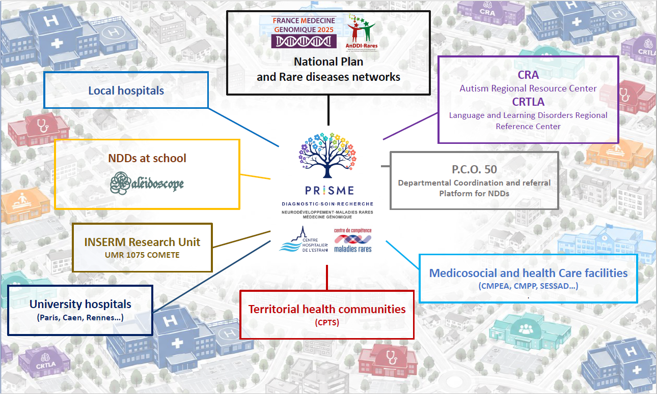
The division places dialogue and joint projects at the centre of its work. Each PRISME project is linked to a partnership designed both to structure the work and to bring it closer to the patient.
This means federating private practices, hospitals, early-childhood services, medico-social organisations, education, research teams, rare-disease networks, regional structures and local authorities.
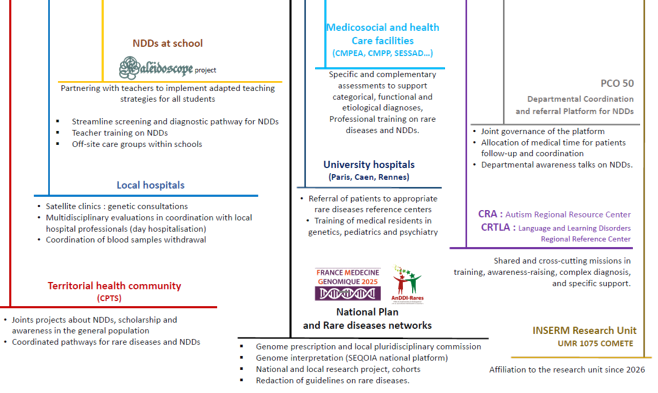
The network is also supported by concrete institutional arrangements: geneticist time is shared with the hospitals of Avranches and Saint-Lô; PRISME contributes to the leadership of the Manche neurodevelopment coordination and referral platform; and the wider regional hospital group supports territorial cooperation.
Management brings institutional weight.
The medical team brings expertise. The territorial model depends on both.
How the territorial ecosystem connects
What hospital management makes possible
Building a project such as PRISME depends on sustained trust between clinical leadership and hospital management.
Management sets the direction and ensures consistency with national policy, assesses feasibility and resources, provides institutional support for territorial action, strengthens team cohesion beyond hospital walls and maintains continuous engagement with partners.
Medical strategy must reconcile proximity and outreach
With a second academic geneticist joining the team, PRISME no longer has to choose between local clinical activity and wider academic outreach. The two practitioners can coordinate multi-site consultations across the department while one or the other participates in research, professional networks or teaching at the Faculty of Medicine in Caen.
Funding is an assembly, not a single budget line
PRISME combines several funding logics: activity-based tariffs, medico-social allocations, public-interest funding linked to rare-disease accreditation and calls for projects. This requires a finance function able to understand and follow several funding mechanisms simultaneously.
Territorial leadership depends on relationships
Professional expertise alone does not create an integrated territorial pathway. Institutional legitimacy, feasibility assessment, responsiveness, team cohesion and continuous engagement with partners are management responsibilities that allow the network to function over time.
The next phase
PRISME already mobilises around 30 professionals specialising in childhood neurodevelopmental disorders. The next ambition is to develop an adult NDD division by 2027, following the same principles of territorial partnership, multidisciplinary working and shared expertise.
A model that can inform other rural areas of Europe
PRISME’s experience is rooted in its own French institutional environment and cannot simply be copied elsewhere. But several conditions appear transferable to other rural European regions.
They include highly specialised practitioners willing to establish themselves outside major metropolitan centres, a formal and functional relationship with universities and specialist networks, and hospital management willing to invest in a territorial model rather than only within the walls of its own institution.
In Normandy, this approach has been supported by the regional health authorities, neighbouring hospitals and local public actors around one common objective: enabling patients to reach highly specialised care more rapidly and closer to home.
For hospital leaders facing unequal access in rural areas, the question is not simply whether highly specialised care can exist outside the big cities.
The question is which partnerships their territory is ready to build.
Source note
This article is based on the author’s professional experience in the development and implementation of PRISME. Service organisation and access-time figures are operational data reported in the submitted manuscript and should be interpreted within their local organisational context.
References and source notes
- Centre Hospitalier de l’Estran — Pôle PRISME.
Institutional information on genetics, neurodevelopment, early intervention, sleep medicine, rare diseases, research and territorial coordination. - French National Strategy for Neurodevelopmental Disorders 2023–2027.
National framework addressing autism, Dys disorders, ADHD and intellectual developmental disorders, including earlier identification and coordinated pathways. - French Law No. 2024-1028 of 15 November 2024.
Legislation relating to identification and support for people with neurodevelopmental disorders and their families. - France Genomic Medicine 2025 Plan.
National framework supporting the integration of genomic medicine and sequencing into specialised care pathways. - Author’s source data.
Descriptions of service organisation, implementation experience, partnerships and access times are based on the submitted manuscript and the author’s professional experience with PRISME.
Image disclosure
The author has indicated that artificial intelligence was used in the generation of some visual material accompanying the original manuscript.
Professional experience. Independent perspectives. European dialogue.
Contributing to Europe’s healthcare management conversation.